


En français? Descend en bas de la page.
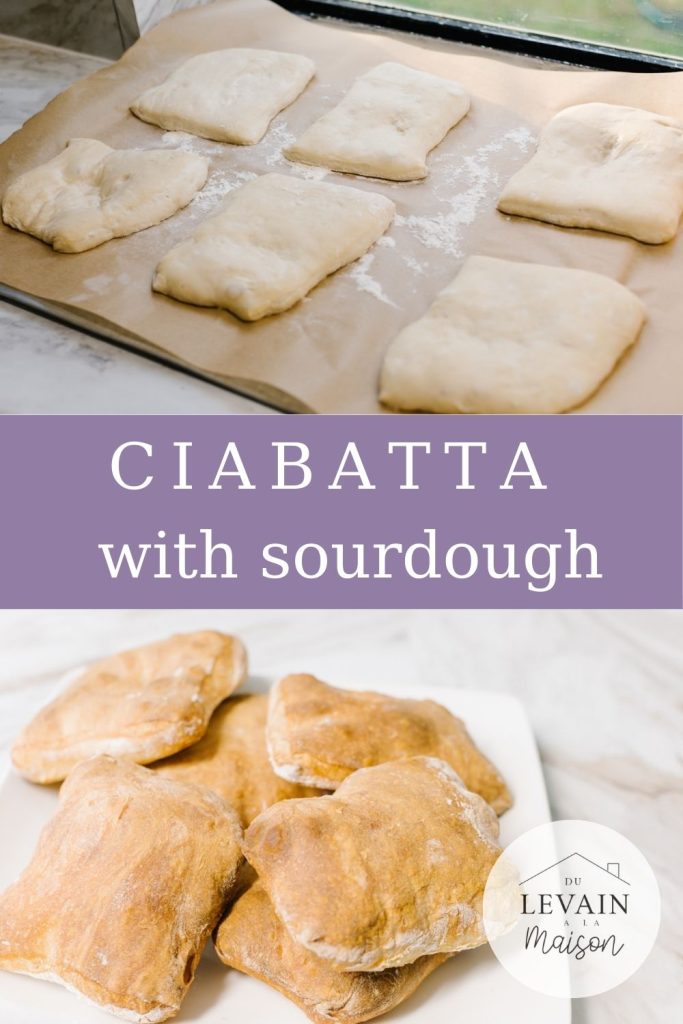
I love this recipe. This bread is different from regular bread, the size is perfect for a sandwich. We love making it to prepare our picnic… both outside the house and in the park or garden. And honestly, it is a very simple bread to make.

The ingredients
TIPS
- Use active sourdough, it is the sourdough that allows the dough to rise
The steps – illustrated recipe for sourdough ciabatta
In a bowl: mix the flour and water, then cover with a towel and let rest for 20 minutes (autolyse).


Add the sourdough starter and salt, mix well (with your hands) and let rest for 20 minutes.


Add the olive oil and incorporate. Then perform 4 sets of « stretch and fold » every 30 minutes. This takes 2 hours.

Cover the bowl and put the dough directly in the refrigerator for 8 to 12 hours (up to 24 hours). After this fermentation, take the dough out of the refrigerator: it will have doubled in size, and you will see bubbles.

Flour the work surface and transfer the dough (you can use a flexible scraper to help). Spread the dough into a rectangle with your hands and cut 6 to 8 rectangles.

Place on a sheet of parchment paper that has been lightly floured. Cover with a kitchen towel and let rest for 1 to 2 hours. The dough will rise a little.


Preheat the oven to 450°F or 230°C. Then, place the dough on a baking sheet.
Place a dish filled with water in the oven and bake the dough for 15 minutes at 450°F or 230°C. Then 10-15 minutes at 400°F or 200°C. Then, take it out of the oven to let it cool and then enjoy!


Sourdough ciabatta
Ingrédients
- 80 g of sourdough starter active
- 400 g of bread flour
- 300 ml of water at room temperature
- 5 g of salt
- 8 ml of olive oil
Instructions
- In a mixing bowl: mix the flour and water, then cover with a towel and let rest for 20 minutes (autolyse).400 g of bread flour, 300 ml of water at room temperature
- Add the sourdough starter and salt, mix well (with your hands) and let rest for 20 minutes.80 g of sourdough starter, 5 g of salt
- Add the olive oil and incorporate.8 ml of olive oil
- Perform 4 sets of « stretch and fold » every 30 minutes. This takes 2 hours.
- Cover the bowl with plastic wrap and put the dough directly in the refrigerator for 8 to 12 hours (up to 24 hours).
- Take the dough out of the refrigerator: it will have doubled in volume, and you will see bubbles.
- Flour the work surface and transfer the dough (you can use a flexible scraper to help you).
- Roll out the dough into a rectangle with your hands and cut 6 to 8 rectangles.
- Place on a sheet of parchment paper that has been previously floured. Cover with a kitchen towel and let rest for 1 to 2 hours. The dough will rise a little.
- Preheat the oven to 450°F or 230°C.
- Place the dough on a baking sheet.
- Place a dish filled with water in the oven and bake the dough for 15 minutes at 450°F or 230°C. Then 10-15 minutes at 400°F or 200°C.
- Let cool and then enjoy.
J’adore cette recette. Ce pain change du pain habituel, la taille est parfaite pour un sandwich. Nous adorons en faire pour préparer notre pique-nique…autant hors de la maison qu’au parc ou au jardin. Et franchement, c’est un pain très simple à réaliser.
Les ingrédients
CONSEILS
- Utilisez du levain actif, c’est le levain qui permet la pousse de la pâte
Les étapes – la recette en image du pain ciabatta au levain
Dans un saladier : mélanger la farine et l’eau puis couvrir d’une serviette et laisser reposer 20 minutes (autolyse).
Ajouter le levain et le sel, bien incorporer (avec les mains) et laisser reposer 20 minutes.
Ajouter l’huile d’olive et incorporer. Puis réaliser 4 sets de « tire et plie » (stretch and fold) toutes les 30 minutes. Cela prend 2 heures.
Filmer le bol et mettre la pâte directement au réfrigérateur pendant 8 à 12 heures (jusqu’à 24 heures). Après cette fermentation, sortir la pâte du réfrigérateur : elle aura doublé de volume, vous verrez des bulles.
Fariner le plan de travail et transvaser la pâte (vous pouvez vous aider d’un racloir souple). Étaler la pâte en rectangle avec les mains et couper 6 à 8 rectangles.
Déposer sur une feuille de papier sulfurisé préalablement fariné. Couvrir d’une serviette de cuisine et laisser reposer 1 à 2 heures. Le pâte gonflera un peu.
Préchauffer le four à 450°F ou 230°C. Puis, déposer la pâte sur une plaque de cuisson.
Placer un plat rempli d’eau dans le four et enfourner la pâte pendant 15 minutes à 450°F ou 230°C. Puis 10-15 minutes à 400°F ou 200°C. Ensuite, sortir du four pour laisser refroidir puis déguster !
Ciabatta au levain
Ingrédients
- 80 g de levain (actif)
- 400 g de farine de pain
- 300 ml d'eau à température ambiante
- 5 g de sel
- 8 ml d'huile d'olive
Instructions
- Dans un saladier : mélanger la farine et l'eau puis couvrir d'une serviette et laisser reposer 20 minutes (autolyse).400 g de farine de pain, 300 ml d'eau à température ambiante
- Ajouter le levain et le sel, bien incorporer (avec les mains) et laisser reposer 20 minutes.80 g de levain, 5 g de sel
- Ajouter l'huile d'olive et incorporer.8 ml d'huile d'olive
- Réaliser 4 sets de "tire et plie" (stretch and fold) toutes les 30 minutes. Cela prend 2 heures.
- Filmer le bol et mettre la pâte directement au réfrigérateur pendant 8 à 12 heures (jusqu'à 24 heures).
- Sortir la pâte du réfrigérateur : elle aura doublé de volume, vous verrez des bulles.
- Fariner le plan de travail et transvaser la pâte (vous pouvez vous aider d'un racloir souple).
- Étaler la pâte en rectangle avec les mains et couper 6 à 8 rectangles.
- Déposer sur une feuille de papier sulfurisé préalablement fariné. Couvrir d'une serviette de cuisine et laisser reposer 1 à 2 heures. Le pâte gonflera un peu.
- Préchauffer le four à 450°F ou 230°C.
- Déposer la pâte sur une plaque de cuisson.
- Placer un plat rempli d'eau dans le four et enfourner la pâte pendant 15 minutes à 450°F ou 230°C. Puis 10-15 minutes à 400°F ou 200°C.
- Laisser refroidir puis déguster.


My favorite kinds of rolls, and I have not made them in ages. Time to make some! Your recipe sounds very easy to follow too and it’s in my baking cue!